2/18/2012
Today was another awesome day in San Francisco! It started out with a Cornbread Blueberry muffin from
Arizmendi Bakery. Yum!
Arizmendi Bakery in the Sunset District
And what an exhibit...
In a word... INCREDIBLE! I have never seen so many Titian paintings in one place! Nor such a large collection of Renaissance masterpieces by Giorgione, Tintoretto, Veronese, Bordone, Palma and more. So many wonders from the famous Gemäldegalerie in the Kunsthistorisches Museum. The Habsburg collection right here in San Francisco! Be still my heart! :-)
I left the exhibit (twice!) feeling both exhausted and exhilarated!
Since photography was not allowed, here are some borrowed images from Wikipedia with some impressions of the paintings and some information I remember from the guided tour:
Titian [Public domain], via Wikimedia Commons
Tiziano Vecelli (Titian). Portrait of Fabrizio Salvaresio. 1558. Oil on canvas.
Salvaresio was one of Venezia's political leaders during the Renaissance. The painting was one of several portraits in the second room - all depicting male patriarchs from prominent Venetian families. These men were, in effect, the city's kings.
The brown and black clothing Salvaresio wears signifies power and position. Although the austere colors seem somewhat plain, the material was very expensive. The choice of color had to do with Sumptuary Laws. From the Medieval period and throughout the Renaissance, individuals from each social strata had very specific dress codes. These religious laws maintained a social hierarchy and firmly established spiritual barriers to vanity. Because flaunting wealth was considered a sinful act, men in Venice's government wore brown and black. That is not to say that this portrait doesn't hint at Salvaresio's wealth or the availability of colorful materials. Notice the fur lining the inside of his clothing. The rich material is hidden beneath the brown because wearing fur openly would be brazen and sinful.
I find the ornate and very expensive silk belt around his waist especially fascinating. This swath of silk is not merely a beautiful and decorative element of Salvaresio's dress; its rich pattern and bright colors symbolize Venezia and her monopoly on trade with the East. Importing goods like silk into Europe drove the Venetian economy and made her one of the richest principalities in Europe!
The next room had three amazing glories by Montegna!
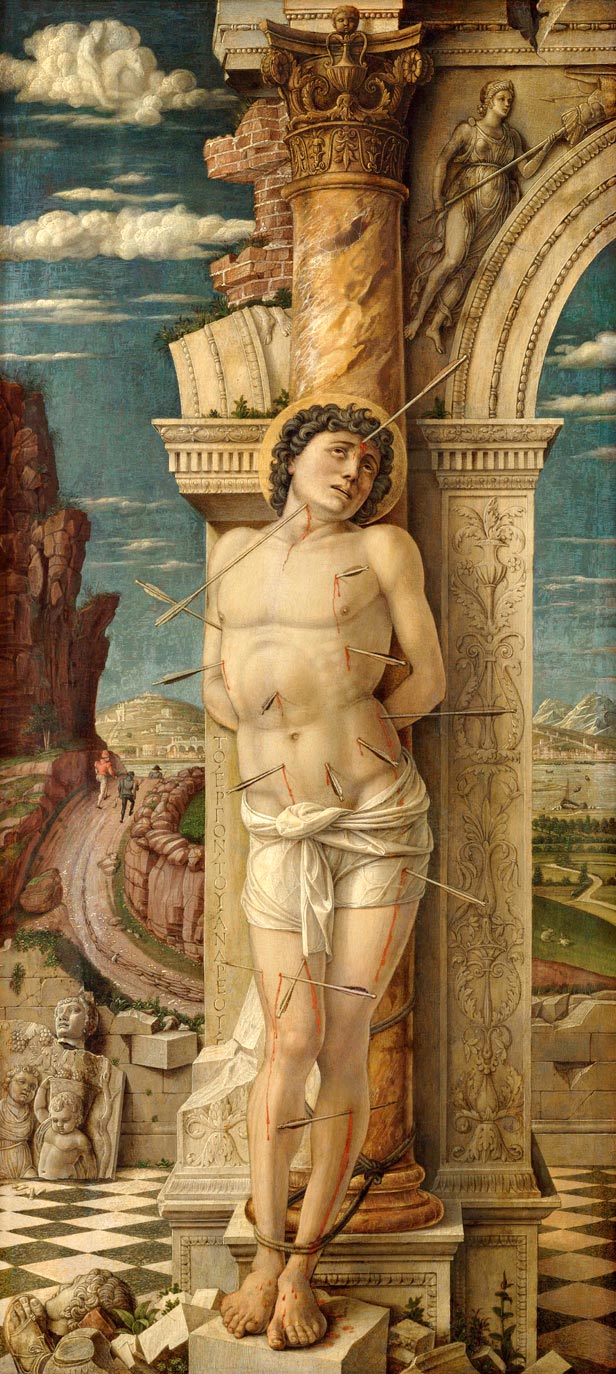
Andrea Mantegna [Public domain], via Wikimedia Commons
Andrea Mantegna. Saint Sebastian. Egg tempera on panel. 1457-1459.
What is so amazing about Mantegna? Beyond his beautiful choices of color and stunning compositions, he (1) painted using egg tempera and (2) his style is an interesting part of a dialogue regarding "what is art?" during the Renaisssance.
(3) Unlike the rest of the artists in this exhibit, Mantegna painted using egg tempera! The product of his work is stunning. This painting, and two others, were accomplished using tiny brushes and pigment mixed with a raw egg- a medium that dries very quickly and is very unforgiving. Unlike slow drying oil paint, which lends hours and days for blending and shading colors, egg tempera dries almost immediately. Montegna had only a brief window of time to apply paint to canvas or board and layer colors for effect. What Montegna was able to accomplish within such constraints is amazing! His Saint Sebastian rivals the master oils in composition, color, expert shading, and detail!
(4) According to the audio-tour, Montegna's paintings are distinct because his figures and other elements have a sculptural quality. This was significant during the Renaissance because there was great debate over what genre of art was superior: painting or sculpture? Although they also painted, many artists like Michelangelo, claimed sculpture as superior. Montegna favored painting. In this work, Sebastian stands on a pedestal much like a statue would. Detailed relief sculpture covers the arch at Sebastian's back and fragments of sculpture are scattered among the temple ruins at his feet. I also love the tiny details Montegna includes. My favorite is the horse and rider forming out of a cloud in the upper left hand corner.
Andrea Mantegna [Public domain], via Wikimedia Commons
Andrea Mantegna. The Sacrifice of Isaac. Tempera on panel. 1490.
There were two other Mantegna paintings next to Saint Sebastian. I didn't find good images for both, but here is one showing The Sacrifice of Isaac. Again you can clearly see Montegna's familiarity with sculptural design in the way the figures seem to pop out of the picture plane as if they have three dimensions. In addition, his choice of a monochromatic color palette brings to mind marble and stone sculpture. The two paintings reminded me of the illusionist ceilings I saw in Florence's Pitti Palace!
The next room was Giorgione....
Giorgione [Public domain], via Wikimedia Commons
Giorgione. Youth with an Arrow. 1508-1510. Oil.
To me, this master of the Venetian Renaissance is soft, subtle, and majestic. His paintings remind me of Leonardo- especially in the faces of some of his figures and the ethereal qualities achieved by his sfumato style.
Tragically, Maestro Giorgione died too soon. He contracted Plague in 1510, when he was only thirty-two or thirty-three. Some say, he was infected by the Black Death because he stayed with a woman he loved and refused to leave her side when she fell ill and died. But while his life was very short, it was incredibly significant. Before he died, he produced some of the most breathtaking paintings from Venezia's Renaissance and more: he mentored the young Tiziano Vecelli, who we know as Titian!
I absolutely love, love, love Giorgione!

Giorgione [Public domain], via Wikimedia Commons
Giorgione's The Three Philosophers (1508-1509). Oil.
One of the highlights of the exhibit was Giorgione's The Three Philosophers! It is unclear exactly who the three figures represent: the three Magi, the three ages of Man, or perhaps some other mythic or allegorical trio. I found the fine details of the figures' dress and their facial features fascinating, not to mention the background! The guided tour pointed out that the beautiful countryside behind the three figures is mystical and wistful, perhaps because Venezia, a sea-bound cluster of islands, lacks lush green fields, mountains, caves, and forested landscapes. The curator suggested that this painting shows the artist's longing for land in a city surrounded by open water.
This painting also reminded me of Plato's Allegory of the Cave. The young philosopher sitting on rocky steps in a beautiful landscape and staring, with a tilted head and a measure of consideration, at the opening of a deep cavern holds an instrument of science. To me, he recalls lectures on Plato's teachings and the belief that through contemplation and meditation, questioning and pondering, deep study and reasoned argument, one can find wisdom. Perhaps the young man is the philosopher described in Plato's Allegory- the only type of person with the ability to escape the cave's shadows and see the light of the world beyond.

Giorgione [Public domain], via Wikimedia Commons
Giorgione. Portrait of a Young Woman (Laura). 1506. Oil on canvas mounted on panel.
This Giorgione is interesting as well. Like The Three Philosophers, she is somewhat of a mystery. There is no record of who the woman might be or for what purpose the painting was commissioned. Along with her anonymity, the way she is portrayed is mysterious. She doesn't seem to be openly coquettish. Her face is even resolute and grave, yet she is exposing her breast. Her fur collar, the fine cloth of her jacket, its rich color, as well as the fine transparent silk covering her hair speaks of wealth and importance, yet she is unknown. She is a study of contradictions. Somber. Brazen. Earnest. Determined. Innocent. Knowing. Thoughtful. Virtuous. Uninhibited. Mysterious. Unaware of the viewer. Or perhaps just disinterested in the viewer entirely. In any case she is fascinating and it isn't surprising that art historians are taken with her.
The next three rooms were filled with Giorgione's star pupil, Tiziano Vecelli, who we know as Titian!

http://bilddatenbank.khm.at/viewArtefact?id=1934 [Public domain], via Wikimedia Commons
Titian. Tarquinius and Lucretia. 1516-1517. Oil on canvas. 33 in × 27 in.
In this painting, the virtuous Lucretia is about to commit suicide because she has been dishonored by Tarquinius. Her creamy skin and vibrant green dress radiate color and light, as she looks up and out. She seems to be set on an unwavering course to escape the horror of her life. Her expression and dress speak to her dignity and virtue. How bright she is, and how shady the slithering rapist behind her seems. I like that Titian has made her strong, while Tarquinius appears as a weakened shadow. His horrific act places him in eternal darkness, while she becomes synonymous with eternal virtue. In this painting, Tarquinius, despite his great effort, cannot force Lucretia into the shadows.
Titian [Public domain], via Wikimedia Commons
Titian. The Bravo. 1516-1517. Oil on canvas.
The Bravo is the man with the knife behind his back. The other figure? Bacchus- god of wine, intoxication, ritual madness, and ecstasy. This is a painting based on the myth of the Theban king Pentheus arresting Bacchus. Titian captures the moment when the bravo is just starting his attack. The dramatic lighting and the bravo's face in shadow remind me of Caravaggio- a later Italian master.
Titian [Public domain], via Wikimedia Commons
Titian. Portrait of Jacopo Strada. 1567-1568. Oil on canvas.
This painting was very interesting as well. According to the guided tour, Strada was a well-known Venetian art dealer and Titian was not his greatest fan, although this commissioned portrait likely fetched Titian a pretty penny. While clearly highlighting the art dealter's stature and skill, Titian manages to discretely inject some of his derision into the painting. The art dealer reaches back to hold out a beautiful nude statue for the viewer/client to see. The gesture tells you of his pride and love for his profession, of his apt skill in sales, but his expression and the position of his hands around the statue make him look shifty and avaricious. As the curator lecturing mentioned, it's hard to tell whether he is offering his client the statue or is unable to relinquish it. The description of Strada and the details in this painting, reminded me of Gollum, from Lord of the Rings, who chants "My Precious! My Precious!" in a creepy and avaricious voice.
The portrait of Strada is subtle and psychologically gripping. You can almost feel the charged energy vibrating from the art dealer as he tries to sell a sculpture or painting. That is, if he can stand to see the said sculpture or painting leave his possessive hands! Titian = brilliant!

Titian [Public domain], via Wikimedia Commons
Tizian. Isabella d'Este, Marchioness of Mantua. 1534-1536
Isabella d'Este was an avid collector of art, and upon receiving this work- meant to be a depiction of her when she was young- was said to have remarked that even in her youth she had never been THAT beautiful.
Isabella is simply stunning and she reminds me of
La Bella at the Pitti Palace,
also painted around this time. Perhaps, Titian used the same model. If so, I wonder who she was. In any case, this painting is beautiful. There is something in her face and enigmatic expression that is mesmerizing. Her dress and accessories are of the highest quality and fashion. She stares out with both power and innocence. I hope that one day I'll be able to visit her in Vienna.
The next room held two giant "poesie" paintings by Titian. Poesia means poetry in Italian and Titian himself described this style of painting as a kind of visual poetry.
Titian [Public domain], via Wikimedia Commons
Titian. Danaë.1564. Oil on canvas.
This large scale painting is stunning. The "poem" presents Zeus/Jupiter coming down from his throne on Mount Olympus as a shower of gold coins cascading onto Danaë's body. It is through this shower of coins that Jupiter takes Danaë as his lover. The result of their union was legendary. Danaë gave birth to the Greek/Roman hero Perseus.
Digital images don't do the real paintings justice. When you are present to the painting and light hits Danaë and the gold coins, they shine and radiate a warm glow. At least, they do in my experience!
Titian [Public domain], via Wikimedia Commons
Mars, Venus and Amor. 1530. Oil on canvas.
97 x 109 cm.
The other mythological "poesie" in the room was dedicated to the love affair between the Roman god of war, Mars, and the Roman goddess of love, Venus. The colors and composition are flawless.
During the audio tour, the curator of this exhibit from the Kunsthistorisches museum in Vienna noted that this painting is stunning not just for its aesthetic qualities, but for the meaning that Mars, Venus and Amor relates. Venus, the goddess of love, holds such power over Mars, the god of war, because love is the only thing that can truly conquer conflict. Love is always the best hope for a peaceful world and Titian's representation of Love conquering War is quite eloquent.
In the next room there was the work of two other Venetian masters on display:
Paris Bordone [Public domain], via Wikimedia Commons
Paris Bordone. Young Woman at her Toilet. 1550. Oil on canvas.
With her blond hair, luminous skin and fresh beauty, this young woman would have been a Venetian man's fantasy. She is in the prime of health, with rosy cheeks and pearls in her hair. The unbound locks of her blond hair, her lush figure and the pink color of her dress indicate her passion. This girl is the Venetian ideal and Bordone captures her majestically. Perhaps she was a courtesan. I imagine she was commissioned for the private collection of a wealthy man.
Paris Bordone [Public domain], via Wikimedia Commons
Paris Bordone. Allegory of Mars, Venus and Cupid. 1560.
Here is another artist's poem about Mars and Venus. In this version, an angel holds wreaths over the lovers' heads as Cupid showers roses onto Venus. I particularly love the colors. The contrast between the azure blue sky, the strawberry blond hair of Venus and the Angel, and the deep ochre color of Venus's dress is captivating.
Palma il Vecchio [Public domain], via Wikimedia Commons
Palma il Vecchio's Nymphs Bathing. 1525.
This painting reminds me a bit of Leonardo and also Giorgione. The soft background, with rolling hills is strange for the sea-bound Venice. The figures, especially the reclining nude and the face of the nymph to her right is delicate and ethereal. It is a classic and brilliant work!
Jacopo Tintoretto [Public domain], via Wikimedia Commons
Tintoretto. Susanna and the Elders. 1555-1556. Oil on Canvas.
My other favorite from the exhibit was this monumental painting by Tintoretto. It is truly refined and finished, unlike many of his paintings that are more crudely accomplished. As a side note to explain, Tintoretto was in constant competition with Titian. His edge on commissions, was to produce paintings quickly. This painting made me catch my breath!
In Susanna and the Elders, the perverted old men peek at Susanna from behind a screen as she is stepping into her bath. Their contorted postures and shadowy faces are hideous, while she has an idealized beauty.
The biblical story that Tintoretto is illustrating goes as follows: While taking a garden bath, Susanna is observed by two elder men. After watching her bathe, they accost her when she is returning home and demand that she have sex with them or be publicly accused of adultery. She refuses them and is wrongfully sentenced as an adulteress. Just as she is about to be punished for her crime- the penalty for which is death- the proceedings are stopped by a young Daniel. He demands that the elders be questioned and when their stories are shown to be false, Susanna is hailed as a woman of great virtue. In her elegant posture, Susanna is exactly the picture of feminine beauty and innocence, while the elders are depicted in strange and unnatural postures: gawking, perverted, and utterly repellent. I think the artist captured the tone of Susanna's story, and the juxtaposition between youth and old age, brilliantly.
In the last room there was a series of paintings by Veronese. My favorites were:
Paolo Veronese [Public domain], via Wikimedia Commons
Paolo Veronese. Judith with the Head of Holofernes. 1580. Oil.
The detail, the clothing, the expressions, the jewels- everything about these two paintings was stunning!
Paolo Veronese [Public domain], via Wikimedia Commons
Paolo Veronese. Lucretia. 1580-1583. Oil on canvas.
Paolo Veronese [Public domain], via Wikimedia Commons
Veronese. The Anointing of David. 1555. Oil on canvas.
Although, the digital image is small, the actual painting is gigantic! It covered almost an entire wall.
The canvas had a herringbone pattern, which you could see up close on David's arm, as the guided tour prompted. The style and quality of the work was stunning. I particularly liked the animals and how they were placed within the composition.
All in all it was an incredible exhibit! I am ever so grateful to the de Young and the Kunsthistorisches Museum in Vienna for affording all of us the opportunity to see it in San Francisco!
After I left the museum, I walked through the park and bought a late lunch to-go from Arizmendi!
The California Academy of Sciences
Spreckels Temple of Music at one end of the Music Concourse
The de Young Museum from the Music Concourse
Arizmendi Coop. Bakery once again! My delicious Arizmendi pizza with spinach, Feta, Kalmata olives and their always amazing, slightly sourdough-y crust! There is a different pizza every day :-)
On my way out of the City,
I couldn't resist stopping by another favorite bakery in San Francisco before heading home.
A very unassuming and delicious Salvadorean/Guatemalan bakery in the outer Mission:
Andrea Bakery and Cafe!
My favorite pastry is their Langua o Guaracha. These are long and flat "pastries" that taste like a bread stick with crunchy sugary goodness on top. I tried to ask the lady what Langua o Guaracha means and the closest that I could make out (via hand gestures) was something about the pastry being shaped like a tongue and something about kicking or pant legs. The tongue part makes sense. The shape of the pastry and the crunchy sugar does resemble a tongue.
Close up of my Langua o Guaracha- they are ADDICTIVE!
I also bought some Plantain Bread Pudding to try. Here is a piece of the giant slice I shared with friends!